
Accident benefits are staying on Ontario policies as 76% keep coverage since July reforms: Survey
By: Aya Alhakim on October 23, 2026
KEY FINDINGS:
- Awareness of auto reforms is high: 66% of respondents say they are aware car insurance rules changed July 1, 2026, when several accident benefits became optional on Ontario auto policies.
- Most drivers haven't changed their coverage: 76% say they have made no changes to their accident benefits since July 1.
- Over half or 51% surveyed plan to keep accident benefits at renewal: 25% say they are thinking about dropping or lowering accident benefits coverage.
- Many Ontarians aren't familiar with their policy selections: 41% of surveyed Ontarians aren't aware which optional accident benefits are on their policy. Another 21% say they have none of the listed benefits.
- Share of those with or without alternate coverage is similar: 40% say they have coverage apart from car insurance, such as workplace or disability benefits, to help with expenses after an auto collision injury; 44% say they don't.
- Benefit most popular is income replacement: 28% of survey respondents mention having income protection against wages lost after an accident. Before opting out, licensed insurance broker Fleur Dsouza says drivers should weigh small monthly savings against risk of months of lost pay and household costs if injured.
Three months after Ontario made several accident benefits optional on auto insurance policies, over 76% of drivers in a new LowestRates.ca survey say they haven't altered coverage. While awareness of the province's auto reforms that took effect in July runs high at 66%, of those surveyed, 41% aren't well versed with which optional benefits are on their own policy.
66%
Say they are aware of Ontario’s July 1 auto insurance changes
76%
Say they haven’t changed their accident benefits since July 1
41%
Say they don’t know which optional accident benefits they have
As of July 1, 2026, Ontario drivers have the option to remove several accident benefits from their auto policy that were previously mandatory. But policies must carry medical, rehabilitation, and attendant care benefits.
Income replacement, caregiver, non-earner, housekeeping and home maintenance, visitor expenses, lost educational expenses, damage to personal items, death and funeral benefits, and indexation (payouts tied to inflation) have now become optional coverage.
So how are Ontarians approaching optional benefits? Here's what a LowestRates.ca temperature check found in an October survey of 292 Ontarians*.
In this article:
- How many Ontario drivers plan to keep accident benefits at renewal?
- Do Ontario drivers know which optional accident benefits they have?
- Which optional accident benefits should Ontario drivers consider keeping?
- Do Ontario drivers have other coverage to fall back on after a car accident?
- What should you check before opting out of accident benefits in Ontario?
- Frequently asked questions (FAQ)
- Are accident benefits still mandatory in Ontario?
- Did I lose accident benefits coverage on July 1, 2026?
- How much will I save by dropping optional accident benefits?
- Do optional accident benefits cover passengers in my car?
- Will my workplace benefits cover me after a car accident?
- Can I add accident benefits back after I remove them?
- How do I find out which accident benefits are on my policy?
- Methodology
How many Ontario drivers plan to keep accident benefits at renewal?
More than half of surveyed respondents plan to hold onto accident protection at renewal. Benefits that became optional stay on your policy until you remove them. Most respondents, or over 76%, have not altered their coverage thus far. Only 15% say they have made changes, while 8% say they don't know or don't have a car insurance policy.
Looking ahead to renewal, plans seem to shift:
- 51% say they are not thinking about dropping or lowering accident benefits coverage
- 25% say they are planning to make policy modifications at renewal
- 11% say they already have dropped or lowered coverage
- 14% say they don't know or don't have a car insurance policy
Because many Ontario auto insurance policies renew annually, some respondents may have not yet reached their first renewal since reforms took effect on July 1.
Fleur Dsouza, licensed insurance broker and LowestRates.ca expert advises anyone weighing a cut to put savings in context. She says premium savings are modest, and the tradeoff is "a small monthly saving against risk of covering months of lost pay and household costs yourself".
For Dsouza, the key question is whether a driver could manage without coverage. "If you couldn't comfortably cover a few months without income, or if others depend on you, the small premium savings may not be worth the [risk] exposure."
Read next: How Ontario drivers are saving money on premiums: survey
Do Ontario drivers know which optional accident benefits they have?
A large percentage or 41% say they can't identify which optional accident benefits they have on their policy. Another 21% say they have none of the listed benefits.
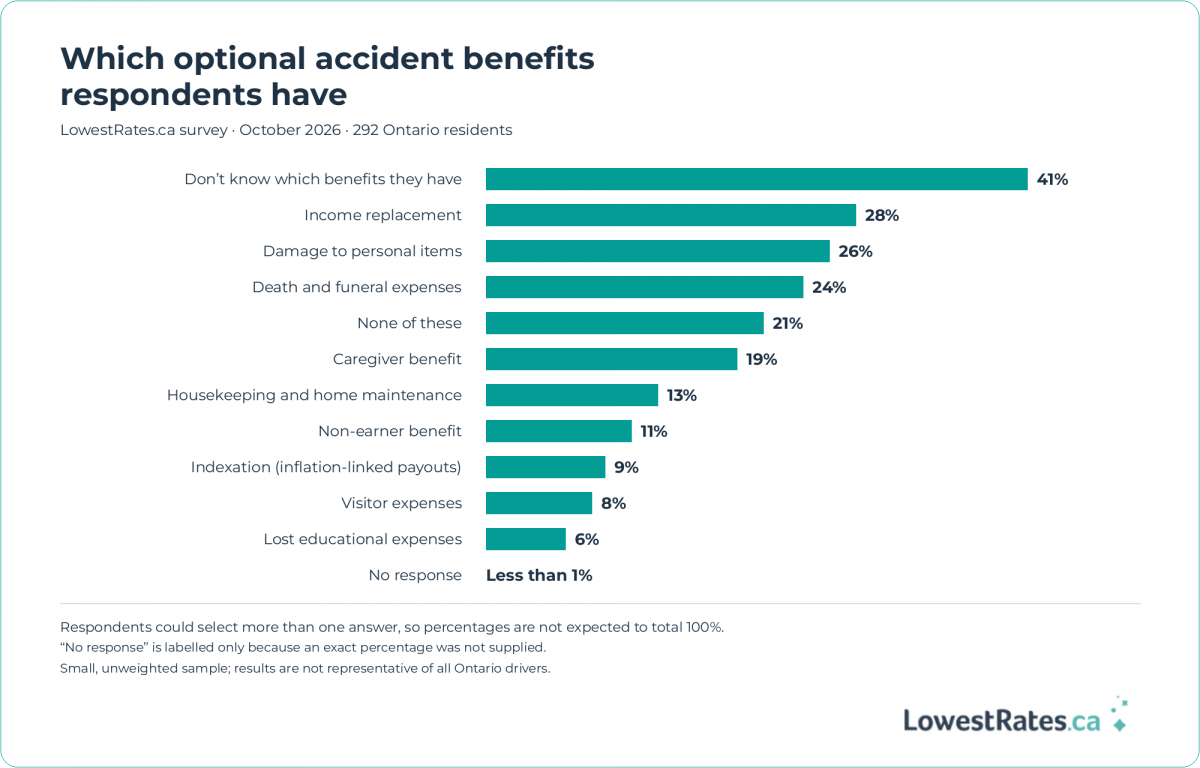
Among specific endorsements, 28% of respondents know their coverage includes income replacement. Less than 10% say they have indexation, visitor expenses, and lost educational expenses.
Which optional accident benefits are on your policy right now?
| Optional accident benefit | % of respondents |
|---|---|
| I don't know | 41% |
| Income replacement | 28% |
| Damage to personal items | 26% |
| Death and funeral expenses | 24% |
| None of these | 21% |
| Caregiver benefit | 19% |
| Housekeeping and home maintenance | 13% |
| Non-earner benefit | 11% |
| Indexation (payouts tied to inflation) | 9% |
| Visitor expenses | 8% |
| Lost educational expenses | 6% |
| No response | <1% |
Respondents could select more than one answer.
"Before deciding to drop accident benefits, it helps to know what you'd actually be giving up," says Dsouza.
Read more: How Ontario's July 1, 2026 auto insurance reforms affect drivers and non-drivers
Which optional accident benefits should Ontario drivers consider keeping?
"Drivers may be most likely to overlook benefits that cover everyday life during recovery," Dsouza says.
Here is how these benefits help after a crash, based on Dsouza's assessment:
- Income replacement: Rent, groceries, and loan payments continue even when a paycheque stops. This benefit that 28% respondents say they have purchased is what accounts for most of the premium savings from opting out, Dsouza says.
- Caregiver and housekeeping benefits: 19% surveyed have caregiver, 13% have housekeeping and maintenance. These payouts can help with costs like childcare, cleaning, and home upkeep when an injury leaves you unable to manage yourself.
- Non-earner benefit: Designed for people without employment income, such as students or retirees. Only 11% of respondents report having this endorsement.
- Higher catastrophic coverage: Not a July 1 change, but Dsouza says it is worth asking your broker about, since very serious injuries can involve long-term care needs.
Dsouza also highlights that since reforms took effort optional benefits now protect a narrower pool of people: "Optional benefits now apply only to you, your spouse, your dependents, and listed drivers, so [unlisted] passengers aren't included."
Do Ontario drivers have other coverage to fall back on after a car accident?
Fewer than half or 40% say they have coverage apart from car insurance, such as workplace or disability benefits, that could help pay for expenses after an accident injury. A similar share or 44% mention having no other recourse for optional benefits, while 16% say "maybe".
Even for the 40% who have other coverage, Dsouza cautions that it may not do what drivers expect. "Other plans can help, but they often fill the gaps only partly," she says.
Since July 1, 2026, for accidents on or after that date, the auto insurer pays first for medical and rehabilitation expenses, excluding medication, which preserves workplace health benefits for other needs. But Dsouza notes that this change "doesn't replace lost income or pay for childcare and household help, which is what the optional auto benefits cover".
Workplace and private plans also differ widely. Dsouza suggests finding out what your plan covers, when payments start, for how long you can receive benefits, whether there are annual limits to certain coverage, and whether a spouse and children are also included.
"Some people have no such plan, and others have one that ends if they lose their job," she says.
For the 16% who answered "maybe", her advice is to hold off on cutting optional benefits. "If you aren't sure what your workplace covers, keep optional benefits on your policy and remove them later, once you've confirmed what you have."
What should you check before opting out of accident benefits in Ontario?
For 25% of respondents weighing a change, and 41% who don't know what's included in their policy, Dsouza's guidance comes down to four steps:
- Find out what's on your policy now. Optional benefits rolled forward automatically on July 1 unless you removed them. Your renewal documents or your broker can confirm what you currently hold.
- Check what your other plans actually cover. "Before opting out, check whether your workplace or private plans truly cover car accidents, how much of your income they replace, and when payments begin," Dsouza says.
- Weigh savings in premiums against your household's risk exposure. Ask whether you could manage a few months without income, and whether anyone depends on you for care or household work.
- Don't rush, but don't stall either. "Insurers say you can add or remove optional benefits, so there's no rush to cut them," Dsouza says. "It's an easy topic to put off in a busy week, but a delay can leave you without coverage at the moment you need it, and you can't add benefits after a crash has happened."
A broker can walk you through each option and explain how optional accident benefits can work for your situation, Dsouza says.
Frequently asked questions (FAQ)
Are accident benefits still mandatory in Ontario?
Medical, rehabilitation, and attendant care benefits remain mandatory on every Ontario auto policy, but several accident benefits are now optional. As of July 1, 2026, income replacement, caregiver, non-earner, housekeeping and home maintenance, visitor expenses, lost educational expenses, damage to personal items, death and funeral, and indexation benefits are optional.
Did I lose accident benefits coverage on July 1, 2026?
No, not unless you removed it. The previously mandatory benefits roll forward automatically on existing policies. In a LowestRates.ca survey, 76% of respondents say they haven't changed their coverage since July 1. Most Ontario drivers appear to retain accident benefits.
How much will I save by dropping optional accident benefits?
The savings are modest, and most of them come from income replacement, according to Fleur Dsouza, licensed insurance broker and LowestRates.ca expert. The exact amount depends on your insurer and policy.
Do optional accident benefits cover passengers in my car?
No. Since July 1, 2026, optional benefits apply only to the insured policyholder, their spouse, dependents, and listed drivers. Passengers not listed on your policy are not included in insurance payouts.
Will my workplace benefits cover me after a car accident?
Only partly, in many cases. Since July 1, 2026, your auto insurer pays first for medical and rehabilitation expenses (excluding medication) for accidents on, or after, that date. Workplace and disability plans generally do not replace lost income to the same degree or pay for childcare and household help, and they vary widely in what they pay, when payments start, and whether there are coverage limits.
Can I add accident benefits back after I remove them?
Yes, insurers say you can add or remove optional benefits, but only before a crash. Benefits kick in only if they were included in your policy at the time of your accident.
How do I find out which accident benefits are on my policy?
Check your policy documents or renewal notice, or ask your broker or insurer to confirm and explain each optional benefit. In the survey, four in 10 respondents didn't know which optional benefits they currently have in their policy.
Methodology
LowestRates.ca surveyed 292 Ontario residents* in October 2026 about awareness of, and changes to, accident benefits coverage on their car insurance policies following Ontario's July 1, 2026 auto insurance reforms. The sample is small and unweighted, and the results should be read as a gauge of public awareness and intentions rather than representative of all Ontario drivers.


