
Near 40% of Canadians surveyed are uninsured for e-bikes or e-scooters amidst unified calls for stronger regulation of growing road hazard: Survey
By: Aya Alhakim on September 25, 2026
KEY FINDINGS:
- Many riders remain uninsured: Four in 10 surveyed Canadians who own an e-bike or e-scooter said they have not purchased insurance for their electric two-wheeler, despite potential liability and property damage risks.
- Injuries are becoming a growing concern: Five per cent of surveyed Canadians reported being involved in a collision with an electric two-wheeler, while doctors report seeing more severe injuries linked to these devices, including a rise in pediatric cases.
- Insurance options remain limited: Legal expert Michael Parrish says at least one program, Pedal Power Insurance, sells dedicated liability coverage for e-bikes and e-scooters in Canada (outside Quebec), but no law or regulation requires riders to carry it.
- Rules vary widely across Canada: Provinces and municipalities regulate how e-bikes and e-scooters can be used, while the federal government regulates the products themselves. Differences in oversight and design standards have created a patchwork regulatory landscape.
- Safety concerns extend beyond the devices themselves: Emergency physician Dr. Brian Rowe points to speed, rider impairment, and interactions with motor vehicles as key factors contributing to serious collisions and injuries.
- Canadians want stronger safety measures: More than 84% of survey respondents selected helmet requirements as a preferred regulatory measure, reflecting broad support for rules aimed at improving rider safety.
- Experts say better regulation could reduce risks: Clearer rules, consistent enforcement, and improved compliance could help address regulatory gaps and improve the overall safety profile of electric two-wheelers.
Canadians are shifting to more affordable personal electric two-wheelers to get around as gas prices near $2/litre across the country. But 40% of those surveyed haven't purchased insurance for their e-bike or e-scooter, a new LowestRates.ca survey found.
Survey respondents expressed overwhelming support for regulatory measures such as helmet requirements, lights and reflectors, age limits, and speed limits as these personal electric vehicles share public roads.
Increased adoption in the absence of regulatory clarity and insurance is showing up in rising road accidents involving e-bikes and e-scooters. In the survey, 5% of Canadians reported involvement in collisions with electric two-wheelers.
"This is not an insurance problem," Michael Parrish says. "This is a regulatory problem and insurance can be part of the solution." Parrish is a partner at legal firm Fasken, with expertise in insurance, transportation, and regulatory matters.
In Parrish's view, the biggest safety risk is not the number of uninsured riders but the number of riders using e-bikes and e-scooters that are more powerful than provincial rules permit.
As policymakers grapple with addressing safety concerns, doctors are also reporting more severe injuries linked to electric two-wheelers, including a rise in pediatric cases.
So how are Canadians dealing with this new breed of vehicles added to already busy roads? Here's what we found from our survey.
In this article:
- How many Canadians ride e-bikes or e-scooters?
- What insurance coverage is available for e-bikes and e-scooters?
- What should riders and parents check before an accident happens?
- How are e-bikes and e-scooters regulated in Canada?
- How do e-bike and e-scooter rules vary across Canada?
- Why are e-scooter and e-bike injuries getting worse?
- What would make e-bikes and e-scooters safer?
- Frequently asked questions (FAQ)
- Methodology
How many Canadians ride e-bikes or e-scooters?
Adoption of personal electric vehicles is on the rise in Canada as they become a more affordable, quick, and convenient means of transportation.
Examples of retail prices for popular e-bikes and e-scooters sold in Canada, from lowest to highest:
| Vehicle Type | Model | Retail Cost (CAD) | Key Features |
|---|---|---|---|
| E-bike | RadKick 7-Speed Electric Lightweight Bike | $1,899 | Lightweight electric bike designed for urban riding |
| E-bike | Aventon Level.2 | $2,099 | 500W motor, front suspension, integrated battery, rear rack, and fenders |
| E-bike | Radster Road Electric Commuter Bike | $2,699 | Commuter-focused electric bike |
| E-scooter | NAVEE V25 Pro | $349.99 | Up to 25 km range and 30 km/h top speed |
| E-scooter | Gyrocopters Flash 6.0 Max | $599.97 | 500W motor, up to 40 km range, and 32 km/h top speed |
| E-scooter | NAVEE GT3 Pro | $699.99 | 1,000W motor, up to 60 km range, and 32 km/h top speed |
Sources: EZbike Canada (Aventon Level.2); Rad Power Bikes Canada (RadKick 7-Speed Electric Lightweight Bike, Radster Road Electric Commuter Bike); Best Buy Canada (NAVEE V25 Pro, NAVEE GT3 Pro, Gyrocopters Flash 6.0 Max). Retail prices and specifications accessed September 2026.
Here's the breakdown of electric two-wheeler ownership from our survey of 744 Canadians:
- 17% say someone in their household rides an e-bike or e-scooter
- 14% say they will buy one in the next two years
- 10% of riders are under 18 years
- 5% reported involvement in an accident either as the driver of a vehicle or rider of an electric two-wheeler
- 40% say they haven't purchased insurance
- 3% say they have bought insurance
What insurance coverage is available for e-bikes and e-scooters?
Insurance for e-bikes and e-scooters in Canada can be complicated.
Dedicated policies are rare, but they do exist. Parrish points to Pedal Power Insurance, a program run by OASIS Outdoor Adventure & Sports Insurance Solutions Inc. and underwritten by insurers including certain Lloyd's of London underwriters, which sells stand-alone third-party liability, accident benefits, and physical damage coverage for e-bikes and electric kick scooters directly to the public.
According to the program's website, it is available across Canada except Quebec and only covers devices with a maximum 500-watt motor and 32 km/h top speed. A claim may be denied if the device does not comply with provincial regulations at the time of a loss, and accident benefits are not offered for electric kick scooters.
Riders who do not hold a dedicated policy may still have some coverage.
Steven Harris, licensed insurance broker and LowestRates.ca expert, says liability protection may be available through a homeowner's, condominium, or tenant insurance policy, provided the e-bike falls within a policy's coverage definitions.
Coverage may come from other sources:
- Home, condo, or tenant insurance may provide liability coverage. Liability protection is generally extended through those policies for covered e-bikes. Parrish notes that liability coverage may also respond if a rider injures a pedestrian and is sued.
- Coverage for e-bike itself may be limited. Harris says e-bikes are often subject to special limits under home insurance policies. Some owners may need to specifically schedule their e-bike or add additional coverage if they want it insured for its full value.
- Auto insurance can become relevant in some crashes. When an e-bike rider is involved in a collision with a motor vehicle, accident benefits or other coverages may be available through a rider's auto insurance policy or that of a family member, depending on coverage purchased.
The increasing road hazard from electric e-bikes underscores the importance of purchasing optional accident benefits that are no longer mandatory coverage for drivers in Ontario since insurance auto reforms took effect in July.
Read more: How Ontario's July 1, 2026 auto insurance reforms affect drivers and non-drivers
The survey found that 24 respondents or about 3% reported having insurance for an e-bike or e-scooter, but did not ask for specifications on what type of insurance they had purchased.
Parrish says the scarcity of dedicated products, and the low uptake of those that exist, is tied to the broader regulatory landscape. No law or regulation currently requires riders to carry personal liability insurance for an e-bike or e-scooter, he says.
"Insurers are not going to want to insure a risk that is kind of unregulated," he says. "The insurance will follow the regulations."
One insurer selling policies is not enough to solve the problem, Parrish says. Most riders either don't know the coverage is available or won't buy it unless they are required to. If regulations required insurance for commercial e-bike use, for example, he expects more insurers would be willing to bring a product to market.
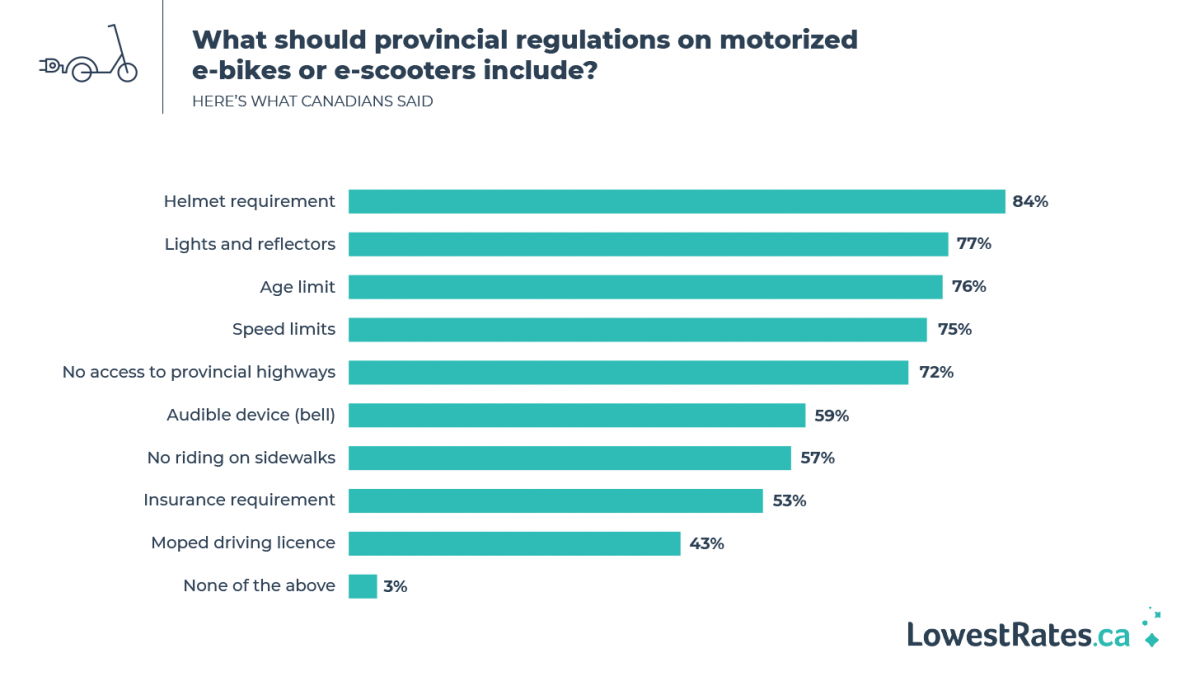
The issue of a lack of insurance requirement surfaced in the survey as well. More than half of respondents or 53% said provincial regulations on motorized e-bikes and e-scooters should include an insurance requirement.
What should riders and parents check before an accident happens?
Understanding where coverage comes from can be important, especially as e-bike and e-scooter use grows.
"Consumers should review their liability limits from both home and auto [insurance] and review their own accident benefit coverages relating to possible injury and liability claims," Harris says.
For higher-value e-bikes and e-scooters, he recommends checking policy limits to determine whether additional coverage is needed.
Parents may also want to understand how their insurance would respond if a child is injured in a crash.
"Parents should look into their own accident benefit coverages under their auto policy to review what coverages they have listed on their policy and look at which additional increased benefits that are available," says Harris.
He recommends speaking with a licensed insurance broker to better understand available coverage options.
How are e-bikes and e-scooters regulated in Canada?
E-bikes and e-scooters are not regulated uniformly across Canada.
"You can't treat e-bikes and e-scooters the same," Parrish says. "They are treated differently legally. The e-bike regulations do not cover e-scooters, and there's not really any e-scooter regulation," he says.
Furthermore, the regulatory framework is split between provinces and the federal government.
"Provinces and territories can mandate which vehicles they allow to be registered and driven on public roadways," Transport Canada said in a statement to LowestRates.ca. According to the agency, municipalities may also establish local traffic bylaws, including rules on where micromobility devices can operate.
That division of responsibilities helps explain why e-bike and e-scooter rules can vary not only between provinces, but sometimes between municipalities as well.
Provinces regulate how these electric two-wheelers are used. Almost every province and territory has rules governing where and how e-bikes can be ridden. E-scooters are different. Parrish says Ontario and B.C. operate pilot programs that allow municipalities to opt in and permit e-scooter use under provincial rules. If a kick-style e-scooter is being used legally in either province, it is likely in a municipality that has chosen to participate.
The federal government regulates products [electric two-wheelers] manufacturers sell. Under the Motor Vehicle Safety Act, Transport Canada oversees the safety requirements that apply to regulated vehicles imported into or manufactured in Canada.
According to Parrish, the biggest gap exists at the federal level. He says questions over whether Transport Canada or Health Canada should oversee smaller e-bikes have left much of the design, certification, and importation of those devices effectively unregulated. E-scooters, meanwhile, fall under Health Canada's consumer product safety framework, which requires products to be safe but does not establish specific design standards.
Parrish says that can create a disconnect between what consumers can buy and what they can legally ride on public roads.
"It is legal to sell a scooter or e-bike that is more powerful than the type of scooter or e-bike that you can use on the road," he says.
Retailers may tell customers a model is intended for private-property use only. "But everyone then just goes and uses it on the road."
That mismatch is what Parrish considers the real safety problem. Electric vehicles ridden in a non-compliant way, rather than a lack of insurance, are what create the risk on public roads, he says.
What buyers can do now: Parrish's advice is simple. Ask the store. "Is this legal to use on the road? Where can I use this?" Most retailers know the local rules and many hand out a brochure explaining where a given model can and cannot be ridden.
How do e-bike and e-scooter rules vary across Canada?
Canadians who ride e-bikes and e-scooters face different rules depending on where they live. Minimum ages, helmet requirements, speed limits, and e-scooter access can vary by province and, in some cases, by municipality.
The survey suggests there is broad agreement on some of the basics. When asked what provincial regulations for motorized e-bikes and e-scooters should include, respondents most often selected helmet requirements (84%), lights and reflectors (77%), age limits (76%), and speed limits (75%).
More than half of those surveyed also selected an insurance requirement (53%), and only about 3% said provinces should impose none of these measures. Respondents could choose more than one answer.
Many of those regulatory requirements already exist in at least some provinces.
| Province | Helmet requirement | Insurance requirement | Minimum age | Speed limit | E-scooter status |
|---|---|---|---|---|---|
| Ontario | Helmet required for e-bike riders; required for e-scooter riders under 18 years | None | 16+ years for e-bikes and e-scooters | 32 km/h for e-bikes; 24 km/h for e-scooters | Municipalities can participate in a provincial pilot program |
| British Columbia | Helmet required | None | 16+ years for standard e-bikes; 14+ years for light e-bikes | 32 km/h for standard e-bikes; 25 km/h for light e-bikes | E-scooters may be used in participating pilot communities |
| Alberta | Helmet required for e-bike riders | None | 12+ years | 32 km/h | No provincewide framework for privately owned e-scooters |
| Quebec | Helmet required | None | 18+ years for e-bikes; 14+ years for electric scooters covered by pilot project | 32 km/h for e-bikes; 25 km/h for e-scooters | Electric scooters operate under a provincial pilot project |
Provincial differences in regulatory approach are most noticeable when it comes to age requirements and e-scooter rules.
Alberta allows e-bike riders as young as 12 years, while Quebec's minimum age for e-bike riders is 18 years.
E-scooters remain tied to pilot programs in Ontario, B.C., and Quebec, while Alberta does not have a provincewide framework for privately owned devices.
Some provinces allow local municipal governments to decide whether e-scooters can operate in their communities, according to a statement from Transport Canada.
Why are e-scooter and e-bike injuries getting worse?
Speed is the common cause of injuries from electric two-wheelers, according to Dr. Brian Rowe, an emergency physician and director of the Emergency Medicine Research Group at the University of Alberta.
"In general, the speed of both devices [e-bikes and e-scooters] worries me, as that impacts injuries when crashes occur," Rowe says.
Rowe points to three overlapping factors: device speed, rider impairment, and interactions with motor vehicles.
What is clearer, he says, is that injuries are becoming more severe.
In Edmonton, hospitalizations related to e-scooter injuries have doubled over the past four years. Dr. Rowe says his team is also seeing "a dramatic rise in serious head injuries and pediatric injuries".
According to a report by the Canadian Pediatric Surveillance Program released August 2026, pediatric specialists documented 10 deaths, 12 ICU admissions, and 26 hospitalizations lasting more than two days over a 12-month period following e-scooter crashes involving children and teens across the country. Half of these cases involved head injuries.
The increase in injuries is also beginning to affect policy decisions. At BC Children's Hospital, there were 81 emergency department visits related to e-scooter use between April 2025 and April 2026, more than double the previous year, according to a report by The Canadian Press. In response to similar concerns, some B.C. school districts have banned or restricted e-bikes and e-scooters on school property, citing injuries among child and teen riders.
The biggest misconception Canadians have about e-bikes and e-scooters, Dr. Rowe says, is that they are safe.
"These are high-speed devices that don't allow for riders to adjust in the event of an interaction with another shared path user," he says, whether that is a pedestrian, cyclist, or another e-scooter rider.
The LowestRates.ca survey found that nearly 10% of respondents have someone under the age of 18 years in their household who rides a personal electric vehicle.
According to Parrish, parents should also understand potential legal consequences of a crash. If a child crashes into a pedestrian or damages a vehicle, the child or parent could face a lawsuit. Home insurance liability coverage may respond in some circumstances, though exclusions may apply.
"Even more importantly, your child could get really hurt," Parrish says. "I think that's the most important thing."
Asked what single measure policymakers could take to reduce injuries, Dr. Rowe points to helmets.
"Because head injuries are so severe and life-altering, I would recommend mandatory helmet use laws," he says. "Speed is harder to regulate, but that would also be important to address."
That helmet recommendation aligns with LowestRates.ca survey findings. A helmet requirement was the most selected regulatory measure among respondents, at over 84%.
What would make e-bikes and e-scooters safer?
Both experts agree that setting rules followed by enforcement could raise the safety profile of electric two-wheelers.
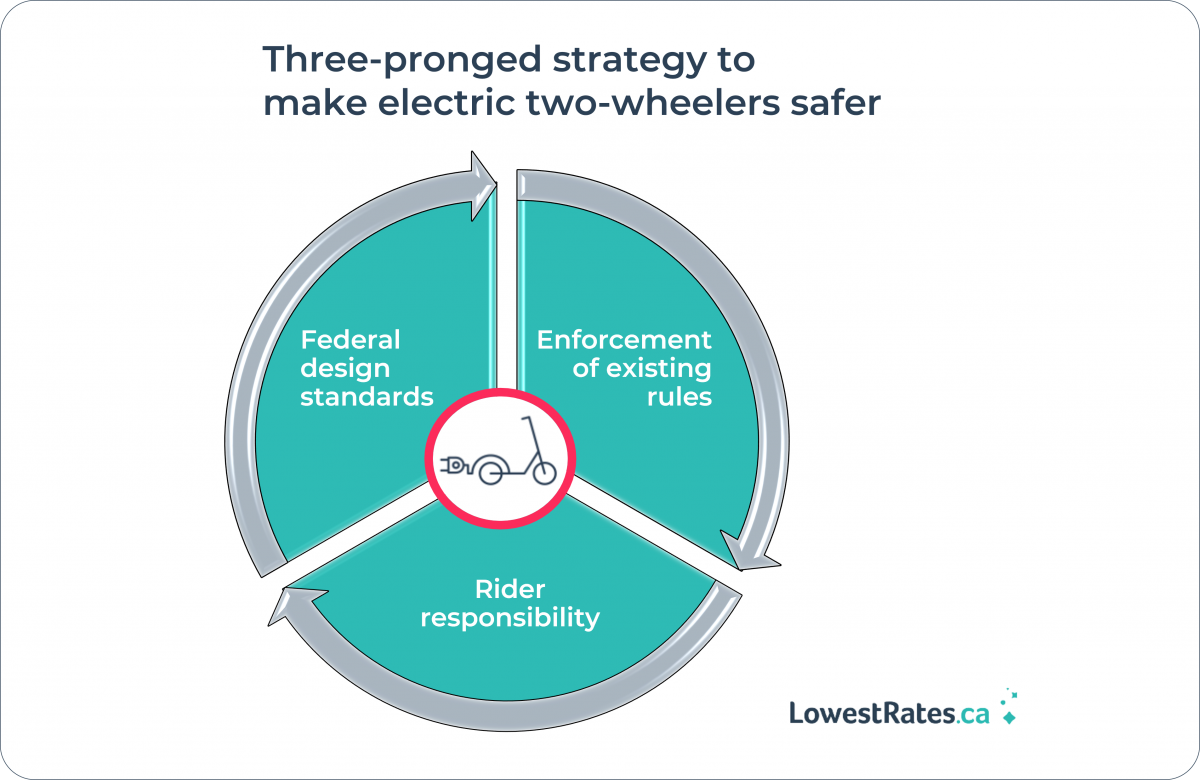
Parrish describes what he calls a three-pronged approach:
- Federal design standards. Comprehensive rules on how large, how fast, and how efficiently an e-bike or e-scooter can brake, backed by certification, with a ban on importing or selling non-compliant devices. "There is a 1,000-page book of regulations that says this is everything your car needs to have and do," he says. "We need something similar."
- Enforcement of existing rules. Provincial use regulations already prohibit sidewalk riding, excessive speed, riding without a helmet, and using oversized or modified bikes. The problem is that police have limited capacity to enforce them, so the consequences are low. "There's no consequence," Parrish says. "So people just go nuts."
- Rider responsibility, especially for commercial users. Parrish notes much of misuse comes from food delivery riders. He suggests a low-cost commercial licence, with delivery platforms responsible for ensuring their riders hold one. "If you use your e-bike the wrong way and you lose your licence, you lose your job. And that will control people's behaviour."
E-bikes and e-scooters are becoming a larger part of Canadians’ mobility, but the systems surrounding them have not evolved at the same pace. Rules vary across provinces and municipalities, insurance remains difficult to navigate, and hospitals are treating a growing number of serious injuries.
For Parrish, the missing piece is regulatory clarity, particularly design standards that keep overpowered, non-compliant electric vehicles off public roads. For Dr. Rowe, it is reducing the severity of injuries, particularly head injuries.
Both experts agree that clearer rules and better compliance could go a long way toward addressing growing risks associated with these personal electric vehicles.
Policy discussions are ongoing. Transport Canada says it is working with provinces and territories through the Canadian Council of Motor Transport Administrators (CCMTA), where a working group has been established to examine issues related to micromobility devices, including maximum-speed allowances and other vehicle-safety considerations.
Frequently asked questions (FAQ)
Do I need insurance to ride an e-bike or e-scooter in Canada?
No law or regulation currently requires it, according to Michael Parrish, though he says at least one program, Pedal Power Insurance, sells dedicated e-bike and e-scooter liability coverage to the public in Canada outside Quebec. Most e-bikes and e-scooters also fall outside standard auto insurance coverage because they are not typically classified as motor vehicles. Liability coverage under a homeowner's or tenant's policy may respond in some situations, though exclusions can apply.
Are e-bike and e-scooter rules consistent across Canada?
No. Minimum rider ages, helmet requirements, speed limits, and e-scooter access vary by province and, in some cases, by municipality. For example, Alberta allows e-bike riders as young as 12 years, while Quebec's minimum age for e-bike riders is 18 years. E-scooter rules also differ across jurisdictions.
What safety rules do Canadians support most for e-bikes and e-scooters?
Helmet requirements received the strongest support in the LowestRates.ca survey, selected by 84% of respondents. Lights and reflectors (77%), age limits (76%), and speed limits (75%) were also among the most favoured measures.
Why are doctors concerned about e-scooter injuries?
Dr. Brian Rowe says injuries linked to e-scooters are becoming more severe. His team has seen hospitalizations double over the past four years in Edmonton, alongside a rise in serious head injuries and pediatric injuries. He points to speed, rider impairment, and interactions with motor vehicles as key factors contributing to injuries, and recommends mandatory helmet laws to reduce incidence.
Save 20% on average on home insurance
Compare quotes from 50+ Canadian providers in 3 minutes.


.jpg?itok=yqbPkZfk)